
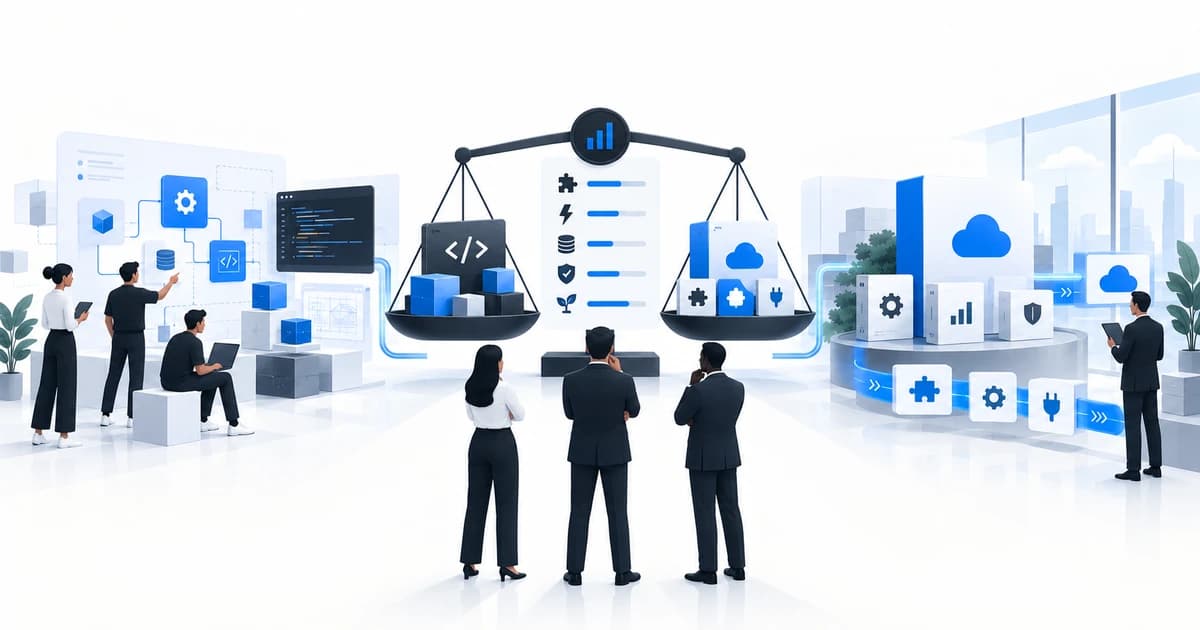
“Build or buy?” sounds like a procurement question. In reality, it is a strategy question about where a company wants to own capability.
The SaaS era made buying software the default. That remains sensible for many categories: email, accounting basics, video conferencing, commodity CRM workflows, payroll engines and standard collaboration. But AI, APIs and composable platforms are changing the economics of custom software. Enterprises can increasingly assemble differentiated systems around standardized infrastructure instead of building everything from scratch.
So the decision is no longer binary. Leaders now have at least four choices: buy, configure, integrate, or build a strategic product.
Buy when the process is not a competitive advantage
Buying is usually correct when:
- the business process is standardized across the industry;
- speed matters more than differentiation;
- switching cost is manageable;
- vendor workflows are acceptable;
- compliance or infrastructure is better handled by a specialist provider;
- internal ownership would create more maintenance than strategic value.
If 90 percent of your process looks like everyone else's, custom software may simply recreate an existing market category at higher cost.
Build when the workflow embodies your advantage
Custom product engineering becomes more compelling when the workflow itself is part of how the company wins.
Typical signals include:
- unique operating logic that standard SaaS forces you to abandon;
- data flows across several systems and teams;
- automation directly changes margin, service quality or speed;
- customer experience depends on process integration;
- the company needs to embed proprietary AI, rules or decision logic;
- the capability may later become an external product or platform.
This is where “custom software” should be treated differently from a traditional one-off IT project. If the capability matters strategically, it needs product ownership, a roadmap, measurement and long-term engineering stewardship.
The hidden cost of buying: operational fragmentation
Organizations often optimize each software purchase locally. Sales picks one tool, HR another, operations a third, customer service a fourth. Each decision may be rational, but the total architecture becomes fragmented.
The cost appears later as:
- duplicate data;
- manual handoffs;
- inconsistent permissions;
- reporting reconciliation;
- automation that breaks between tools;
- employees entering the same information repeatedly;
- AI systems that cannot act reliably because context is spread across applications.
A “cheap SaaS stack” can become expensive when the business must employ people to bridge its gaps.
The hidden cost of building: permanent ownership
Building is not automatically strategic. A company that builds must own:
- product decisions;
- security and access control;
- data lifecycle;
- uptime and incident response;
- release management;
- technical debt;
- integration changes;
- user adoption.
The question is therefore not “Can we build it?” but “Is this capability important enough that we want to own its evolution?”
A practical four-question framework
1. Does the capability differentiate the business?
If not, buy first.
2. Does software constrain the operating model?
If standard tools force costly workarounds, build becomes more attractive.
3. Is there a durable data or automation advantage?
If the system can accumulate proprietary process knowledge, build may create compounding value.
4. Can the company sustain product ownership?
Without an accountable owner and engineering lifecycle, a custom system becomes a liability.
Hybrid is increasingly the default
The strongest architecture is often hybrid: buy identity, cloud, payments, messaging or commodity infrastructure; build the orchestration and domain layer that makes the business unique.
That approach aligns with the broader shift toward composable enterprise technology. Gartner has described AI-era software markets as moving away from rigid packages toward combinations of reusable and bespoke components. The objective is not maximum custom code. It is maximum strategic control with minimum unnecessary ownership.
At NAIT, we use the same lens when evaluating strategic product engineering opportunities: what should remain a commodity, what should be integrated, and what capability is important enough to become a product the business truly owns?
References & further reading
- Gartner, Metamorphosis: Software, Sourcing, and the Enterprise Tech Market
- McKinsey, Products and platforms: Is your technology operating model ready?
Discuss a build-vs-buy or product engineering decision with NAIT