
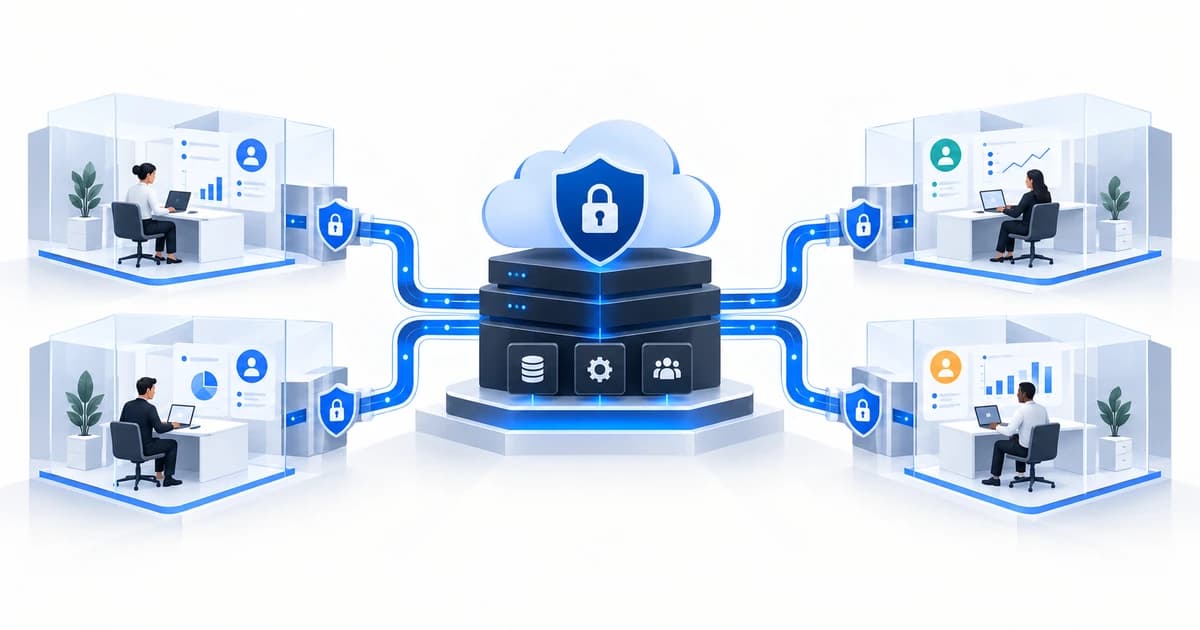
For a multi-tenant SaaS product, one promise is more fundamental than almost every feature: Customer A must never see or change Customer B's data.
That sounds like a backend requirement. In reality, tenant isolation is a product capability spanning schema, permissions, APIs, realtime, files, search, exports and user interface behavior.
Tenant context must be explicit
A robust SaaS architecture needs a clear answer to one question for every business record: Which organization owns this?
Common design tools include:
organization_idor equivalent tenant key;- foreign-key relationships that preserve ownership;
- server-side authorization policies;
- scoped storage paths;
- tenant-aware background jobs and webhooks;
- audit logs that record actor and organization.
The exact implementation varies, but implicit tenancy is dangerous. If ownership is derived from a fragile client-side assumption, one missing filter can become a data leak.
Frontend role checks are not security
Hiding an “Admin” button is useful UX, but it does not authorize an action. A user can still call an API directly.
A mature SaaS product separates:
- UI role gate: what the user should see;
- server authorization: what the user is allowed to execute;
- database isolation: which rows the request can read/write.
Row-level security can be a powerful control because it moves tenant boundaries closer to the data, but it must be tested by role and operation. SELECT, INSERT, UPDATE and DELETE may have different rules.
Super-admin paths deserve special scrutiny
Internal platform administrators often need cross-tenant capabilities for support, billing or account operations. That creates a privileged path that should be explicit and narrow.
Questions to ask:
- Which actions truly require cross-tenant access?
- Are they logged?
- Can support staff accidentally operate in the wrong tenant?
- Are destructive actions confirmed with organization context?
- Do background tools inherit more privilege than necessary?
The safest design makes exceptional power visible rather than hiding it behind ordinary application behavior.
Realtime and files can bypass assumptions
Teams often focus on database queries while forgetting other channels.
Realtime subscriptions should be tenant-scoped. Storage buckets and signed URLs should enforce ownership. Search indexes, exports, notifications and analytics payloads should not accidentally mix tenants.
A product can have perfect table-level policies and still leak information through a notification or file link.
Error states are part of security truth
Suppose a permission query fails. If the UI interprets that as “user has no permission,” the system may appear secure but produce false operational conclusions. If a data query fails and the UI renders “no records,” a manager may make a decision based on incomplete data.
Security and data truth therefore meet in state design:
DENIED ≠ FAILED
EMPTY ≠ FAILED
ZERO ≠ UNKNOWN
This matters in admin tools, billing, payroll, token allocation and API-key management.
Test the boundaries, not only the happy path
A meaningful multi-tenant test matrix includes:
- user A reads tenant A → allowed;
- user A reads tenant B → denied/zero according to policy;
- manager/admin mutations by operation;
- direct API call without frontend navigation;
- realtime subscription across tenant boundary;
- file access across tenant boundary;
- missing or null organization context;
- privileged super-admin exception.
The evidence label matters too. A hidden button proves UI behavior. It does not prove row-level security.
Trust compounds with architecture
Enterprise customers increasingly evaluate not just features but control: who can access what, how actions are logged, and whether the product can scale without increasing ambiguity.
Multi-tenant security should therefore be designed as part of the product promise from the beginning. Retrofitting it after growth is much harder because data, permissions and workflow assumptions are already embedded throughout the system.
NAIT approaches B2B SaaS architecture with tenant boundaries, permission truth and auditability as first-class product requirements—not implementation details to revisit later.