
One of the most persistent mistakes in enterprise technology is treating a strategic software capability as a temporary project.
A project has a defined scope, budget and end date. A product has users, outcomes, operating costs, feedback and an evolving environment. That difference becomes even more important with AI, where models, data, policies, prompts, integrations and user behavior change continuously.
If the software matters to how the business competes or operates, it needs permanent ownership.
Projects optimize delivery. Products optimize outcomes.
Project governance naturally asks:
- Are we on time?
- Are we on budget?
- Did we deliver the agreed scope?
Those are useful controls, but they do not tell you whether the system created business value.
Product governance asks different questions:
- Are users adopting it?
- Is the workflow faster or more reliable?
- Are support costs falling?
- Is conversion improving?
- Are we reducing manual work or operational risk?
- What should we change next based on evidence?
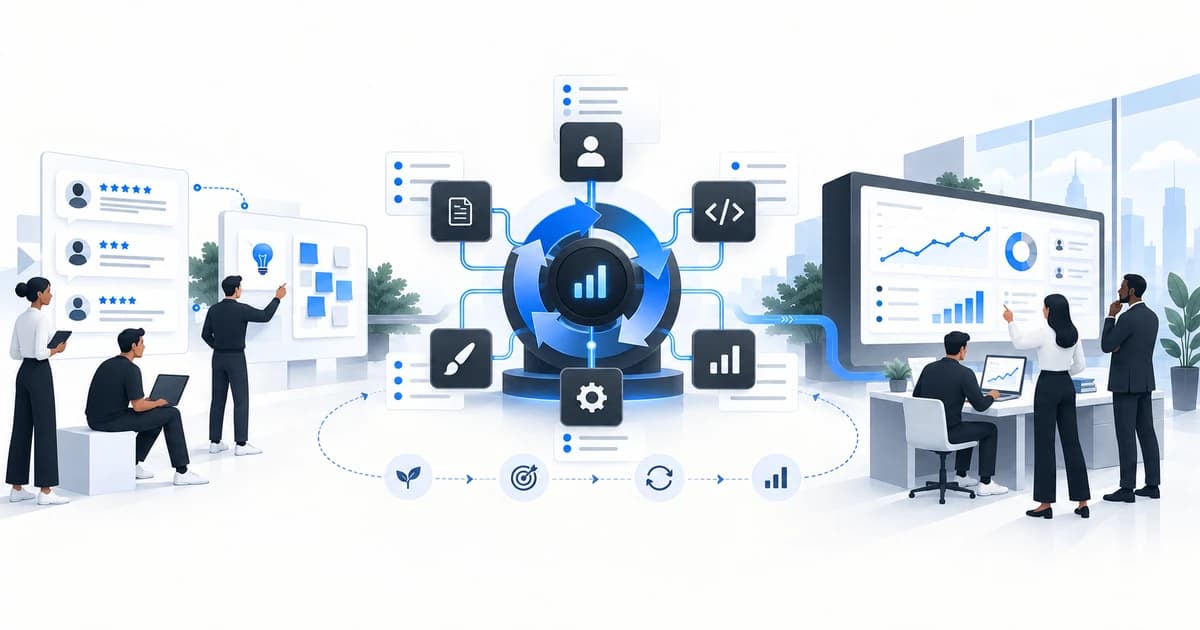
That shift—from output to outcome—is the core of a product operating model.
Cross-functional ownership reduces handoffs
Traditional IT delivery often separates business analysis, design, engineering, testing, operations and security into different queues. Every queue creates waiting time and information loss.
A product team instead brings together the people needed to improve a specific user or business outcome. The exact structure varies, but accountability is shared around the product rather than a temporary scope document.
McKinsey's research on product and platform operating models has linked higher operating-model maturity with stronger business outcomes. The more useful lesson is not the headline statistic; it is the mechanism: closer business-technology collaboration, better prioritization, faster feedback and more deliberate technical-debt management.
AI makes permanent ownership unavoidable
A traditional rules-based application may run for years with relatively stable behavior. AI systems are more dynamic.
Teams need to monitor:
- model quality and drift;
- prompt and retrieval changes;
- data quality;
- tool permissions;
- user feedback;
- cost per inference/workflow;
- failure and exception patterns;
- policy and security controls.
An AI feature that is “launched and handed over” without an accountable product owner will usually degrade in usefulness or accumulate risk.
Product teams need economic boundaries
Permanent ownership does not mean unlimited investment. A product should have an explicit value model.
For an internal operations product, that might be reduced handling time, fewer errors or lower coordination cost. For customer-facing software, it might be revenue, retention, conversion or service differentiation. For an AI product, the value should be compared with inference cost, implementation cost and human review cost.
A good product operating model makes investment decisions continuously rather than waiting for an annual project cycle.
The platform layer matters too
Product teams move faster when they can reuse common capabilities: identity, audit logs, messaging, data access, AI gateways, observability, deployment pipelines and permission systems.
This is why mature technology organizations distinguish products from platforms. Products serve user outcomes. Platforms reduce the cost of repeatedly building the capabilities those products need.
A company does not need dozens of platform teams. It simply needs to recognize what should be shared and governed once rather than copied across every application.
How to start the transition
For one important system, assign a permanent accountable owner. Define a small set of outcome metrics. Create a single prioritized backlog spanning product, engineering and operational improvements. Establish a regular review based on evidence, not project milestones.
Then ask a powerful question:
If this system is still important in three years, who is responsible for making it better every month until then?
If the answer is unclear, the organization still has a project—even if everyone calls it a product.
NAIT approaches strategic software and AI as products with an operating lifecycle. The codebase matters, but so do ownership, decision rights, measurement and the ability to evolve after launch.